

The relationship between dentists and dental labs goes beyond a typical customer-vendor dynamic. It’s a true partnership built on collaboration and trust.
Success in this partnership hinges on open, effective communication. After all, crafting precise restorations requires more than just a prescription. When cases don’t fit or restorations fail, miscommunication is often the culprit.
By working as partners, dentists and labs ensure better outcomes and consistently deliver high-quality patient care.
Since communication ensures smooth collaboration, it’s best to start it early, ideally before a case even begins. Proper case planning can minimize challenges down the road.
This gives dentists a clearer, more complete idea of all the information a lab would need, especially for complex cases. It ultimately prevents unnecessary appointments for the patient and less-than-ideal restorations.
Whether through a quick call, digital case submission notes, or a pre-case consultation, establishing a clear dialogue from the start prevents costly misunderstandings and rework and sets the foundation for efficiency, accuracy, and ultimately, better patient results.
The American College of Prosthodontists (ACP)’s position paper on the dental lab-dentist relationship is useful in outlining the responsibilities of both parties. According to ACP, dentists must ensure all impressions, casts, or scans they send to labs are high-quality and that prescription forms are complete, including patient history, expectations, prescribed materials, aesthetic requests, and any other special requirements.
On the other hand, labs must contact the dentist when directions are unclear or if any concerns arise. They may also offer expert guidance on materials and flag potential challenges before fabrication begins. Some clinics and labs utilize checklists for each case submission, ensuring completeness of the information being shared.
When both sides are proactive and accountable, the workflow becomes smoother, reducing errors and delays.
Quick and effective communication can be a challenge due to conflicting schedules and work overload. Using digital tools gives you an open channel for real-time clarifications without taking up too much time. Digital workflow solutions like EviSmart have mobile apps enabling dentists to check and give feedback on case designs with just a swipe on their phones. It also has centralized case tracking that keeps both dentists and labs updated on the progress of each case, further reducing back-and-forth via email or phone calls.
Not all dental cases require the same level of urgency, and an effective prioritization system can help labs and dentists manage their workload. Establishing clear guidelines for rush cases can prevent last-minute bottlenecks: this can mean setting realistic turnaround times, defining premium service options, or allocating resources efficiently.
Dentists can help by providing advance notice for complex cases and avoiding unnecessary rush requests, while labs should communicate their capacity and estimated timelines clearly.
Patient feedback is a valuable yet often overlooked tool in strengthening dentist-lab collaboration. Encouraging open discussions with patients about their experience allows dentists to relay useful insights to the lab, leading to adjustments that enhance future cases.
Payment issues can strain even the strongest dentist-lab partnerships, but clear systems and transparency can prevent misunderstandings. Labs can offer flexible payment plans or tiered service options to accommodate different budgets, while dentists must prioritize timely payments to maintain a healthy working relationship. Automating invoicing, setting up payment reminders, and using digital payment platforms can help streamline these transactions.
Behind every case is a team of professionals working toward a shared goal: delivering the best possible outcome for the patient. Recognizing the challenges each party faces fosters mutual respect and a more productive working relationship.
Dentists juggle patient expectations, time constraints, and clinical complexities, while labs handle intricate fabrication processes, tight deadlines, and technical challenges. Approaching collaboration with empathy, whether by acknowledging concerns, being patient with revisions, offering constructive feedback, or organizing informal meetings every once in a while, helps build trust and cooperation.
Effective dentist-lab collaboration relies on clear communication, shared responsibility, and efficient workflows. By prioritizing early discussions, maintaining open lines of communication, leveraging patient feedback, and addressing logistical challenges like time constraints and payments, dentists and labs can work together more seamlessly.
Technology plays a crucial role in making this collaboration even smoother. AI-powered digital workflow solution EviSmart enhances efficiency with its centralized case tracking feature, allowing both dentists and labs to monitor case progress in real time. With instant updates, secure messaging, and a streamlined workflow, EviSmart minimizes miscommunication and ensures that every case stays on track.
By integrating smart solutions like EviSmart, dentists and labs can strengthen their partnership, reduce errors, and ultimately deliver better patient outcomes.
Learn more about EviSmart for clinics and labs.
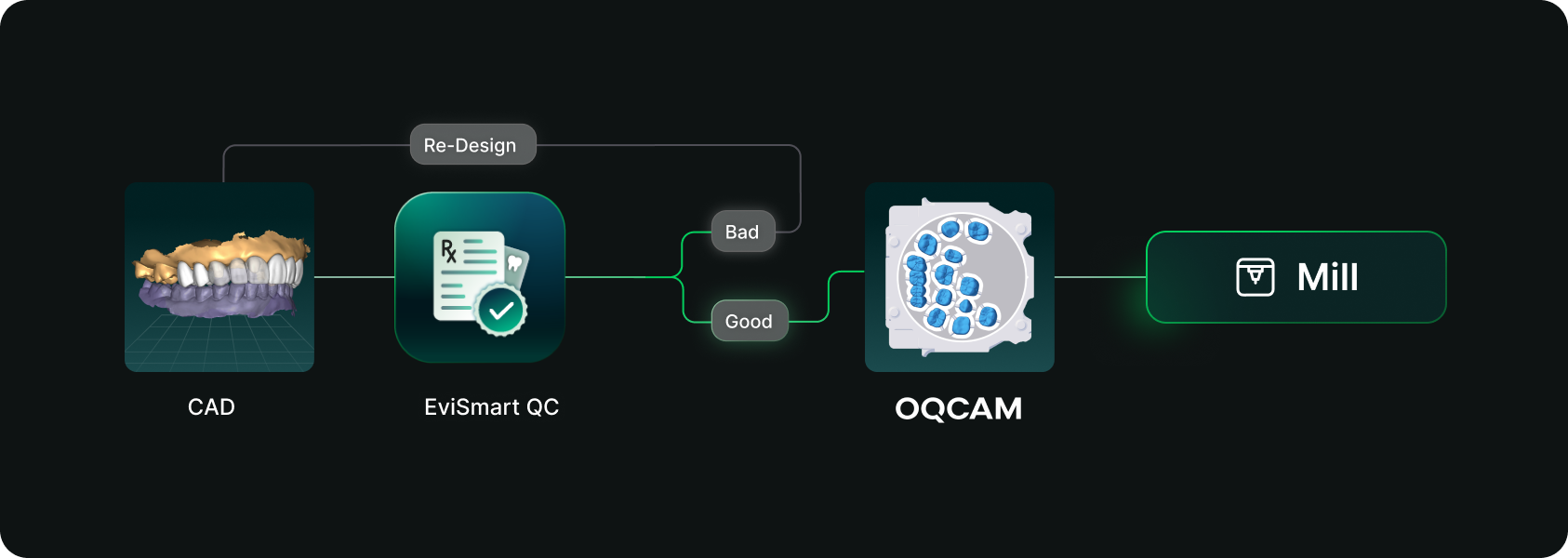
Designs you order from EviSmart arrive in your Oqcam already formatted. Named the way your nesting rules expect, with shade and material attached, and pointed at the machine that case belongs on.
The routing is decided per case. An implant case sends the crown to the mill and puck you cut implant crowns on, and the model to the printer you print models on. Different case types, different machines, chosen automatically rather than by a tech working through a dropdown for every file.
The trigger is QC approval. EviSmart designs your cases your way. The same team works on all your cases and learns what a good case looks like to you. Once your case passes our QC, it triggers a greenlight to send the design directly into your Oqcam account in under a minute.
Once the file arrives in your Oqcam, all your CAD/CAM technicians can review the nested design before starting the mill. That final QC step does not change and is not meant to.
Setup is one session. We connect your Oqcam account and agree where each of your products should go, using the routes and materials you have already built there. Nothing new to create, and you only revisit it if something changes.
Automatic sending only works if you trust what is being sent. Once a case is nested it gets cut, and a design that was not right is wasted material.
You choose what flows. During setup we map only the case types you want moving on their own. Anything unmapped never sends. It waits for you exactly as it does today.
Most labs start narrow. Bread and butter work first, night guards and posterior single units, then widen once they have watched it run for a few weeks. The lab that has been live longest started exactly there and has added case types since.
Your approval stays. This removes the file shuffling between design and CAM. It does not remove your eyes from the build.
For labs outsourcing design work the math gets compelling somewhere north of 30 cases a day into nesting, because that is where the handoff stops being an annoyance and starts being a role.
Not touchless design. Touchless handoff. Every step in that chain that requires judgment should keep requiring judgment, and every step that never did should stop requiring a person.
Nesting requires judgment. Confirming a build requires judgment. Renaming a file so software can read it does not, and never did. It was a workaround that quietly became somebody's job.
Nobody pays you to rename files.


