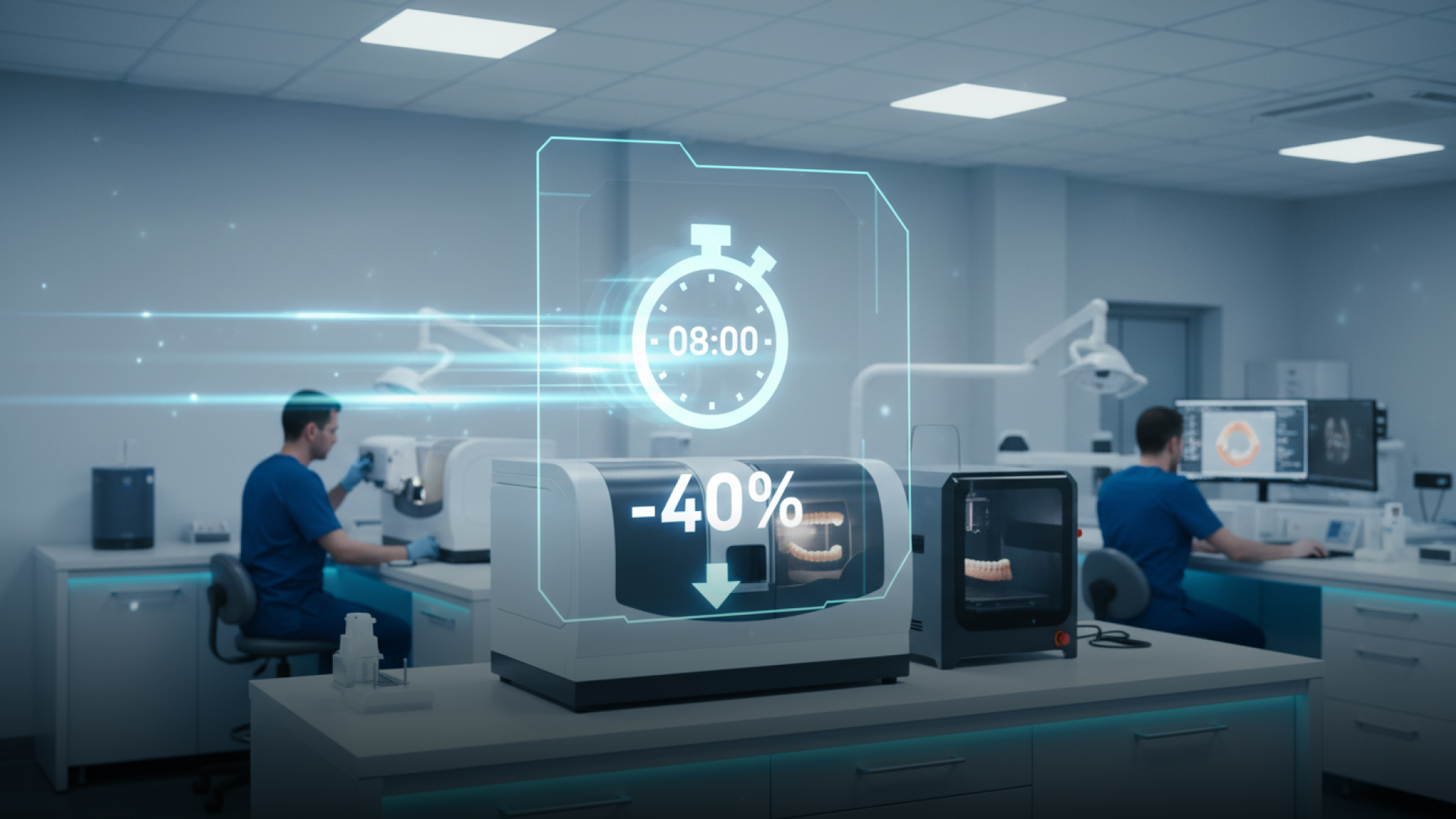
Fast turnaround time is an operational advantage, not a staffing problem.
Labs that cut turnaround time from 1 week to 48 hours aren’t doing it with more technicians.
They’re doing it by removing friction, tightening workflow, and replacing slow manual steps with predictable, automated ones.
This guide breaks down the six root causes of slow turnaround time and what high-performing labs are doing to fix them.
%%1. Dentist Expectations Have Shifted to 48–72 Hours%%
Turnaround time is now a competitive benchmark.
A week used to be fine.
Today, it feels slow.
The issue isn’t skill. It’s workflow speed between steps.
What happens when cases slow down:
- Dentists spread work across multiple labs
- Rushed cases lead to remakes
- Production gets bottlenecked
- Overtime becomes the “solution”
- Margins shrink
Why labs fall behind
Cases sit idle:
- In portals
- In email
- Waiting for paperwork
- Missing files
- Unclear instructions
How top labs are fixing it
They automate early steps so cases enter production fast and complete.
Outcome:
Labs that automate case intake often cut turnaround time from 1 week → 48 hours, without adding headcount.
%%2. Production Loads Are Unpredictable%%
The problem isn’t volume — it’s volatility.
Some days are overwhelming.
Other days are slow.
This unpredictability makes turnaround time inconsistent.
What this creates for managers:
- No visibility into how the day will unfold
- Uneven work distribution
- Constant catch-up cycles
- Chronic overtime
- Lost efficiency
Why this happens
Most labs learn about volume after it hits the team.
What high-performing labs do differently
They surface volume in real time.
Tools like Downloader and QC:
- show exactly how many cases arrived
- flag bad scans immediately
- prevent “surprise” surges
Outcome:
One lab improved EBITDA margin by 8% by stabilizing workflow rhythm alone.
%%3. Workflow Fragmentation Causes Hidden Delays%%
Most delays happen before production even starts.
If you see cases sitting on desks or waiting in trays:
That’s fragmentation.
Where fragmentation begins:
- Cases missing files
- Files named incorrectly
- RXs unclear or incomplete
- Cases buried in inboxes
- No standard intake
- No unified flow
This creates hours of invisible waste.
How leading labs fix it
They make intake predictable:
- cases download automatically
- files are renamed consistently
- scans are QC-checked before the day starts
- everything enters production the same way
Outcome:
Predictable intake = predictable turnaround time.
%%4. Scattered Case Data and Communication Slow Everything Down%%
Information chaos is one of the biggest contributors to slow TRT.
Labs juggle:
- email
- portals
- shared drives
- text messages
- paper RXs
- chat apps
When data is scattered, you get:
- stalled production
- avoidable remakes
- idle technicians
- unclear instructions
- operational stress
How efficient labs solve this
They connect their data and communication into one flow:
- CaseEntry → creates LMS cases automatically
- Comm → links all conversations to the case
- Vault → stores files centrally
- QC → flags issues early
Everything the team needs is in a single place.
Outcome:
A $20M+ lab improved EBITDA from 22% → 30%+ after fixing data flow.
%%5. Technician Shortages Limit Capacity — Even When Demand Grows%%
You can’t hire your way out of this anymore.
The talent pool is shrinking. Training takes time.
Even strong teams get capped by:
- uneven skill levels
- overloaded specialists
- increased remakes
- slow handoffs
- lack of production-ready cases
How labs increase output without hiring
They remove low-value tasks from technicians’ plates.
When repetitive steps are automated:
- techs spend more time producing
- senior techs stop carrying the load
- new techs can contribute sooner
- burnout drops
- throughput increases
Outcome:
Labs using automation unlock 20–30% more capacity without new staff and gain 6–10% EBITDA margin.
%%6. Digital Tools Are Outpacing Lab Workflows%%
Modern dentistry is fast. Most workflows aren’t.
Dentists send digital cases instantly.
But downstream steps are often slow:
- manual downloads
- file sorting
- naming inconsistencies
- missing RXs
- unclear instructions
- unreviewed scans
This mismatch creates friction and delays.
What leading labs do
They smooth the handoff between digital inputs and production:
- unify digital intake
- set clear “production-ready” criteria
- automate downloading, sorting, naming, QC
Small improvements in the first 10 minutes of a case save hours later.
Outcome:
One lab cut TRT from 7 days → 48 hours simply by improving digital intake.
What Fast Labs Have in Common
Across every lab that moves consistently in 48 hours, three things stand out:
1. Predictable Intake
Cases arrive clean, complete, and ready.
2. Connected Communication
No hunting for files. No guessing. No scattered data.
3. Early Automation
Critical steps happen automatically and immediately.
These labs aren’t working harder.
They’re removing friction from the system.
What This Means for Your Lab
If you want:
- faster turnaround time
- more predictable workloads
- fewer remakes
- lower overtime
- higher technician morale
- more capacity without new hires
- stronger margins
The first place to look is your workflow, not your team size.